When Change Knocks: Inside the World of the Pioneer Award
Technology for Quality and Equity
As conversations around digital and AI technologies become increasingly sophisticated, the question of educational equity continues to press against the door. Uneven access to resources, disparities in digital competence, and fragmented institutional systems all shape the fundamental inquiry: who truly stands to benefit from new technologies? For institutions operating with limited means, for academic staff still developing essential digital skills, and for regions where governance structures remain nascent, the path forward is far from straightforward.

Illustration as a medium for shaping the narrative and imagination of pioneers
The United Nations Educational, Scientific and Cultural Organization (UNESCO) has long stood at the forefront of this global transformation, championing the Education 2030 agenda and placing equity at the heart of international higher education. Its advocacy for accessible, high-quality technical, vocational and higher education, particularly for developing countries, remains a critical anchor as the world navigates the accelerating demands of the digital age.
As a UNESCO Category 2 Centre, the International Centre for Higher Education Innovation (UNESCO-ICHEI) aligns its mission closely with the global education agenda. It actively advances UNESCO's priorities, anchors its work in Sustainable Development Goal 4 (SDG 4), and supports higher education institutions (HEIs) in harnessing technology to drive innovation, widen access to lifelong learning, and strengthen the quality and equity of education.
Central to this effort is the International Institute of Online Education (IIOE), established on the principle of "extensive consultation, joint contribution and shared benefits." More than a vehicle for technological empowerment, IIOE serves as a collaborative network that bridges ideas and implementation, connecting global vision with local realities. To capture, recognise and disseminate the innovative approaches emerging from this network, and to turn these experiences into models that others can adopt—the Pioneer Award was created.
At the same time, to bridge ideas with practice and link technology with education, the Pioneer Award was conceived as a platform for genuine multi-stakeholder collaboration. Its purpose extends beyond recognising innovators: it encourages institutions, practitioners and partners to jointly explore new pathways in industry–university collaboration, the integration of industry and education, and the wider digital transformation of higher learning. From the inaugural award supported by BYD to the current edition titled by the BGI Group, the growing involvement of the private sector has helped shift educational equity from an abstract aspiration into a mobilised, and increasingly amplifiable, social endeavour.
The Inaugural Pioneer Award
Against the backdrop of the COVID-19 pandemic's profound disruption to face-toface teaching, the 2023 inaugural award adopted the theme Reform and Innovation in Blended Learning in Higher Education. It was a timely response to the global pivot towards blended modes of delivery. The selection process examined dimensions including classroom innovation, resource development, student support, institutional governance and educational equity.
The award drew submissions from 83 institutions and nine enterprises across 42 countries, recognising 22 outstanding cases that collectively highlighted the dynamic digitalisation efforts taking place in developing countries. The selection process examined key dimensions including classroom innovation, resource development, student support, institutional governance and educational equity. Together, these criteria encouraged the creation of flexible learning pathways that can meet the future needs of international education, maintaining quality while expanding adaptability, and helped narrow educational disparities both between countries and within them.
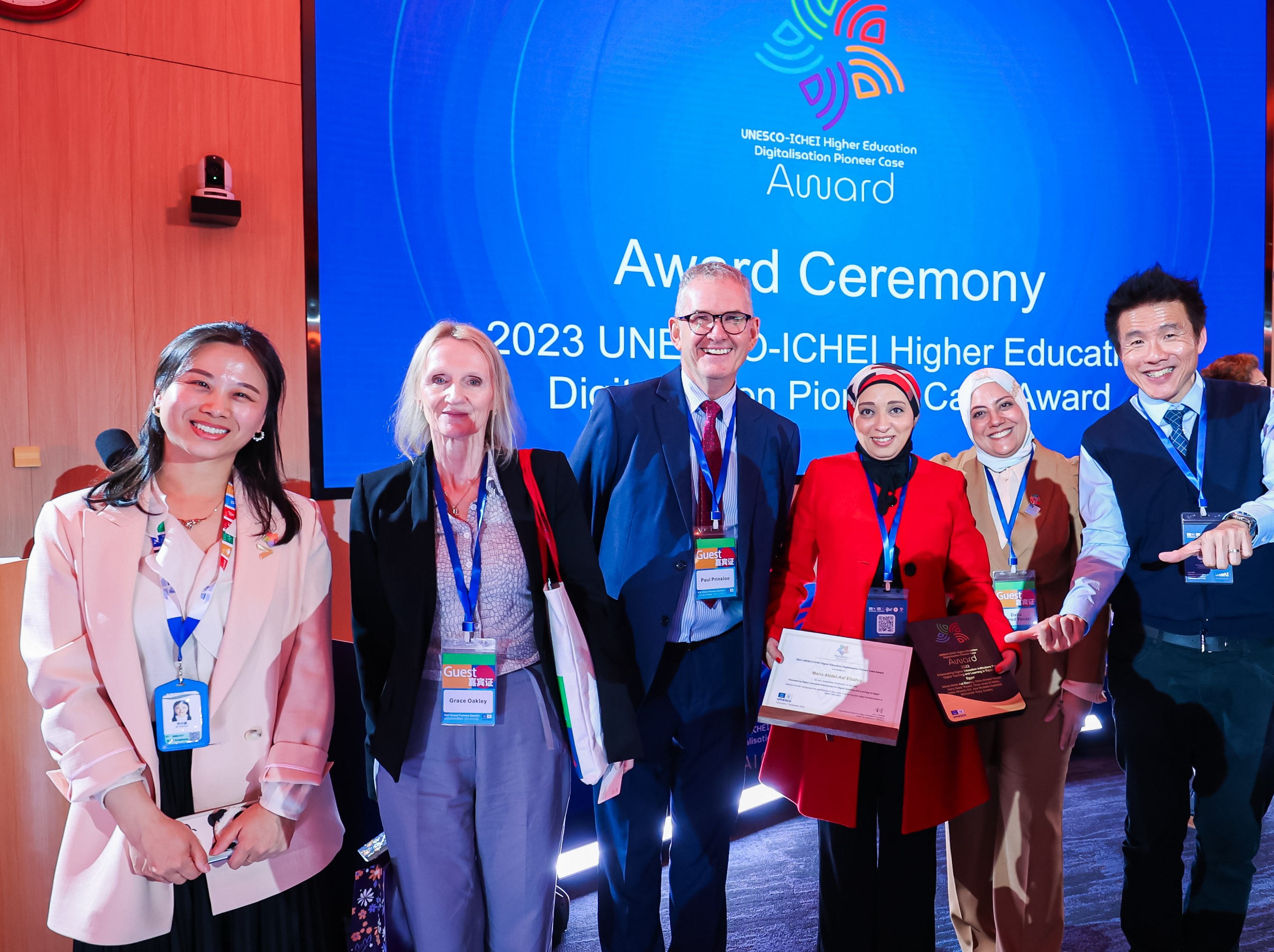
The Inaugural Pioneer Award Ceremony
An Award Mechanism that Inspires Innovation
UNESCO-ICHEI convened an International Review Committee made up of experts from across the UNESCO system, international higher education institutions, industry partners and other fields relevant to the award categories. Reviewing submissions anonymously, the committee brings a breadth of authoritative perspectives to the process. All decisions are reached through majority consensus, ensuring a review procedure that is both rigorous and fair.
Innovation, inclusivity, equity, and sustainability collectively form the four-dimensional review framework of the Pioneer Award. They embody the pursuit of educational equity, the encouragement of collaborative innovation, and the emphasis on long-term mechanisms, aiming to inspire global innovation starting from local practices.
A wave of outstanding cases emerges
The Pioneer Award pays particular attention to the practices of institutions in the Global South, focusing on regional innovation. It encourages institutions to promote the capacity building of the higher education workforce through joint project development, application of the IIOE learning platform, or adoption of certification processes. The review focuses on whether new technologies such as AI and adaptive learning are used to empower teaching and learning, whether innovative collaboration models are formed that drive educational transformation at the regional level.
Equity and inclusion are the cornerstones of multiple Sustainable Development Goals and the core value of the Pioneer Award. In the face of multiple challenges confronting international higher education, including climate change, geopolitical conflicts, and fiscal pressures, particularly against the backdrop of technological disruption, equity and inclusion are especially crucial. Equity, as defined by the Pioneer Award,emphasises local adaptation and scalability.
Outstanding practices should tailor learning pathways based on local needs while possessing the potential for replication and promotion across institutions and regions, with particular attention to supporting HEIs with limited resources, enabling quality educational solutions to take root more widely. Promoting inclusion means ensuring fair representation in higher education for people from diverse backgrounds, encompassing social, economic, racial, gender, physical, and psychological characteristics, among others. Therefore, the Pioneer Award selection prioritises group diversity, focusing on whether projects benefit women, marginalised groups, and other vulnerable learners, and whether specific measures are integrated into the design to support their equal participation.
Furthermore, the award places great importance on project sustainability, i.e., systemic support. It encourages projects to gain recognition at the institutional or policy level, integrate micro-certification into institutional systems, and possess clear future development pathways, thereby achieving a smooth transition from pilot practices to routine implementation.
Tangible Advances in Global Practices
A well-designed mechanism ultimately exists to uncover and empower the outstanding but overlooked practices taking shape at the grassroots. As an ongoing international award, each edition of the Pioneer Award adopts a theme that speaks to the moment, addressing the pressing digital needs of global higher education. From the inaugural award to the second, we can trace how these diverse practices have continued to evolve and deepen in step with the changing priorities of the times.

The Inaugural Pioneer Award Ceremony
Following the inaugural Pioneer Award, the rapid evolution of emerging technologies such as AI opened new possibilities for personalised learning and pedagogical innovation. Online learning and microcertification initiatives gained broader recognition and uptake worldwide, while the digital transformation of higher education shifted towards deeper institutional integration, giving rise to more mature and sustainable pathways for implementation. UNESCO has continued to monitor and shape this landscape, championing a human-centred and ethical approach to AI in education. Its publications (most notably the UNESCO AI Competency Framework for Teachers 2024) provide guidance for institutions and governments seeking to promote inclusive, equitable and high-quality AI applications across the education sector. During the same period, IIOE also made a decisive leap from platform to ecosystem, evolving into a digital transformation alliance linking countries across the Global South. Institutions within this network have achieved tangible progress in advancing localised digital empowerment, strengthening teacher capacity, and fostering curriculum innovation.
Therefore, this edition of the Pioneer Award aims to further deepen ecosystem building, focusing on the IIOE network and local practices. The theme is set as "IIOE Ecosystem-driven Promising Practices: Empowering Workforce, Innovation, and Collaboration", highlighting four key areas: developing digital and AI competencies through IIOE micro-certification, enabling localised digital empowerment initiatives through IIOE National Centres, leveraging smart classroom operations for teaching and learning innovation and excellence, and strengthening global industry-university collaboration for higher education digital empowerment.
This edition drew submissions from 48 HEIs and 13 enterprises across 29 countries, recognising 22 exemplary practices. They showcase some of the most forward-looking achievements emerging from the Global South, from strengthening teacher digital and AI competencies to driving curriculum innovation and upgrading digital infrastructure.
The Pioneers' Echoes Keep Resounding
Over the past two years, we have been heartened to see many partner institutions make striking advances in their digital transformation efforts, with several teams earning recognition in consecutive editions of the award. These cases not only demonstrate the award's sustained role in inspiring educational innovation, but also reveal the vitality and enduring momentum of the projects themselves.
Institutions such as Ahmadu Bello University in Nigeria, Ain Shams University in Egypt, Cadi Ayyad University in Morocco, the Tashkent University of Information Technologies in Uzbekistan, and the University of Engineering and Technology in Pakistan, each recognised in both editions of the award, have continued to make significant, multilayered progress in advancing their initiatives. Their evolving practices offer a vivid illustration of how the Pioneer Award stimulates innovation and nurtures sustainable development.
In the pages that follow, this issue of CLOUD will explore these stories in greater depth. Through conversations with pioneering teams and by retracing the pathways of their projects, we invite you to step into the "cloud" and discover these bright and finely cut stories.

References:
[1] Libing Wang, "Equity should be at the heart of international higher education", UNESCO, 18 December 2023, https://www.unesco.org/en/articles/equity-should-be-heart-international-higher-education(accessed Nov. 8, 2025).

- Bridging the Digital Divide Through GenAI Empowerment: The Mulungushi University Experience
- Weaving a National Digital Ecosystem: ITC and the Making of CCUN
- 2025 New Growth: The IIOE Ecosystem · 2025
- XJTLU: How to Build a Systematic "AI + Education" Ecosystem?
- The Power of Regional Collaboration: IUCEA's AI "Training of Trainers" Programme
- Consensus-Driven Digital Transformation: How the IIOE Nigeria National Centre is Pioneering an AI-Ready Academic Future
- Dialogue with CLOUD: Two Centres, One Pursuit of Excellence
- When Change Knocks: Inside the World of the Pioneer Award