Consensus-Driven Digital Transformation: How the IIOE Nigeria National Centre is Pioneering an AI-Ready Academic Future
The IIOE Nigeria National Centre has exemplified consensus-driven digital transformation. Through comprehensive initiatives including teacher capacity building, it has consolidated campus-based practices into institutional consensus on AI applications, catalysed national policy dialogue, and produced the landmark The Draft Nigerian Higher Education AI Framework. This capacity to translate broad consensus into national policy positions it as a standout model within the IIOE global network.

A Series of Policy Dialogues Led by the IIOE Nigeria National Centre
From Institutional Dialogue to National Transformation
As early as 2023, a UNESCO report emphasised that a critical near-term need — regardless of location or resources — is equipping higher education leaders to advance artificial intelligence implementation responsibly. However, there are significant disparities in the process of building consensus. According to the latest survey, approximately two-thirds of higher education institutions hosting UNESCO chairs or participating in UNITWIN Networks have either established or are currently developing guidelines for the use of AI, of these around 70% of institutions in Europe and North America have developed or are developing guidance, compared to 45% in Latin America and the Caribbean.
In West Africa, the rapid adoption of AI in teaching, learning, research, and administration in Nigeria has outpaced the development of formal governance frameworks.
As AI tools become increasingly prevalent in Nigeria's higher education ecosystem, despite the absence of a national or institutional regulatory framework, there is an urgent need to build capacity among policymakers and stakeholders. This involves deepening understanding of AI's possibilities, limitations, and risks, creating interdisciplinary and cross-sectoral platforms for discussion, and engaging a broad range of voices. Such dialogue should aim to develop consensus frameworks (and subsequent policies) for the responsible, ethical, and safe use of AI in higher education institutions (HEIs). It should also address practical requirements such as connectivity and infrastructure for AI deployment, professional training (including micro-courses for teacher development), and interdisciplinary AI research. Importantly, these initiatives must promote equity, inclusiveness, and access — helping to bridge the digital divide and prevent new forms of marginalisation in Nigeria's higher education system due to AI deployment.
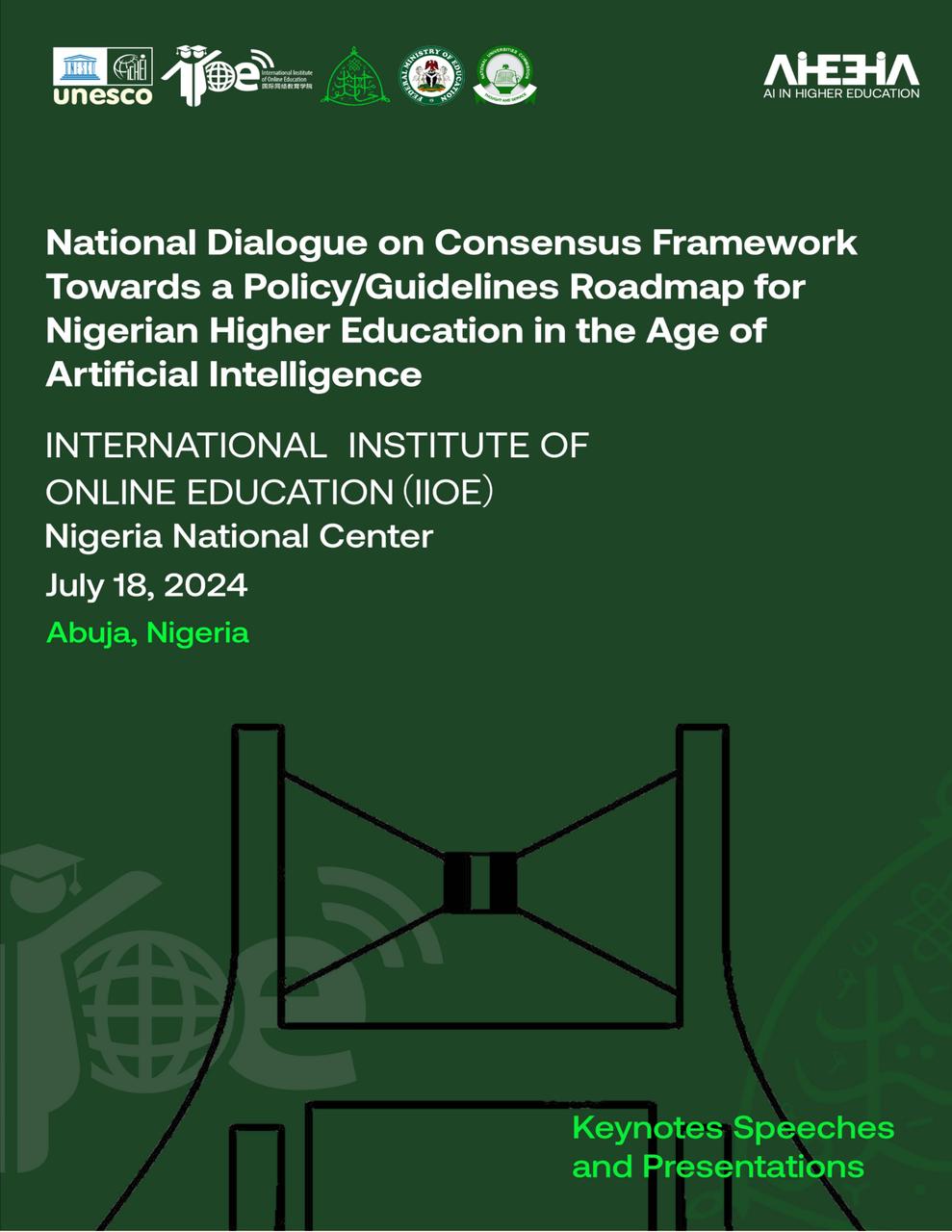
National Dialogue in Abuja
As the IIOE Nigeria National Centre and the 2024 rotating presidency unit, Ahmadu Bello University had astutely identified both the opportunities and challenges presented by AI. In response, it had launched a nationwide capacity-building initiative, adopting a pragmatic and consensus-driven approach to chart a responsible pathway for AI adoption that genuinely aligns with Nigeria's national context.
This approach was predicated on a two-stage engagement model. First, an institutional dialogue at ABU Zaria on November 28, 2023, titled "Generative AI and Higher Education". There were two key presentations: "GenAI: The Technology Explained" by Prof. M. A. Aibinu (Vice Chancellor, Summit University, Offa, Nigeria) and "Exploring GenAI: Ethical Dimensions and Governance" by Prof. M. B. Mu'azu (Director, IIOE Nigeria National Centre) followed by a panel session consisting of faculty, administration and students. These activities provided the platform for comprehensive discussions and analysis of the impacts, challenges, and opportunities presented by generative AI (GenAI) tools and the need for institutional governance frameworks.

The second stage was the one-day National Dialogue in Abuja on July 18, 2024, that brought together federal ministries, regulatory agencies, enterprise partners, academic leaders, faculty, students, and international organisations. The overarching objective of the national dialogue was the need to discuss and formulate a consensus framework towards the development of policy/guidelines for the responsible, ethical and safe use of AI in teaching, learning, research, and decision-making processes within the higher education sector in Nigeria. Others included the need to identify challenges related to the responsible, ethical and safe use of AI and cybersecurity concerns within the higher education landscape as well as the need to facilitate collaboration among academia, industry, and government to ensure a holistic approach to the integration of AI, fostering innovation and knowledge exchange.
Building the Foundation: The 2023–2024 Dialogue Journey
The 2023 institutional dialogue at ABU Zaria laid the groundwork by addressing the ethical, technical, and governance implications of GenAI. It was followed by advocacy visits involving federal ministries and regulatory agencies, including the National Universities Commission (NUC), National Board for Technical Education (NBTE), National Commission for Colleges of Education (NCCE), National Information Technology Development Agency (NITDA), and Nigerian Communications Commission (NCC), industry partners, and student representatives.
Building upon the solid foundation laid by prior engagements, the 2024 National Dialogue successfully forged a core consensus: the imperative to ensure AI is used responsibly, ethically, and safely within the higher education sector. Distinguished national and international experts at the Dialogue jointly called for Nigeria to expedite the introduction of a National Higher Education AI Framework.
Drawing on global best practices, insights from leading institutions, and contributions from local experts, the Dialogue produced a realistic yet ambitious roadmap for AI integration in the Nigeria's higher education ecosystem. This roadmap was aligned with Nigeria's 2024–2028 National AI Strategy of the Federal Ministry of Communications, Innovation and Digital Economy (FMCIDE).
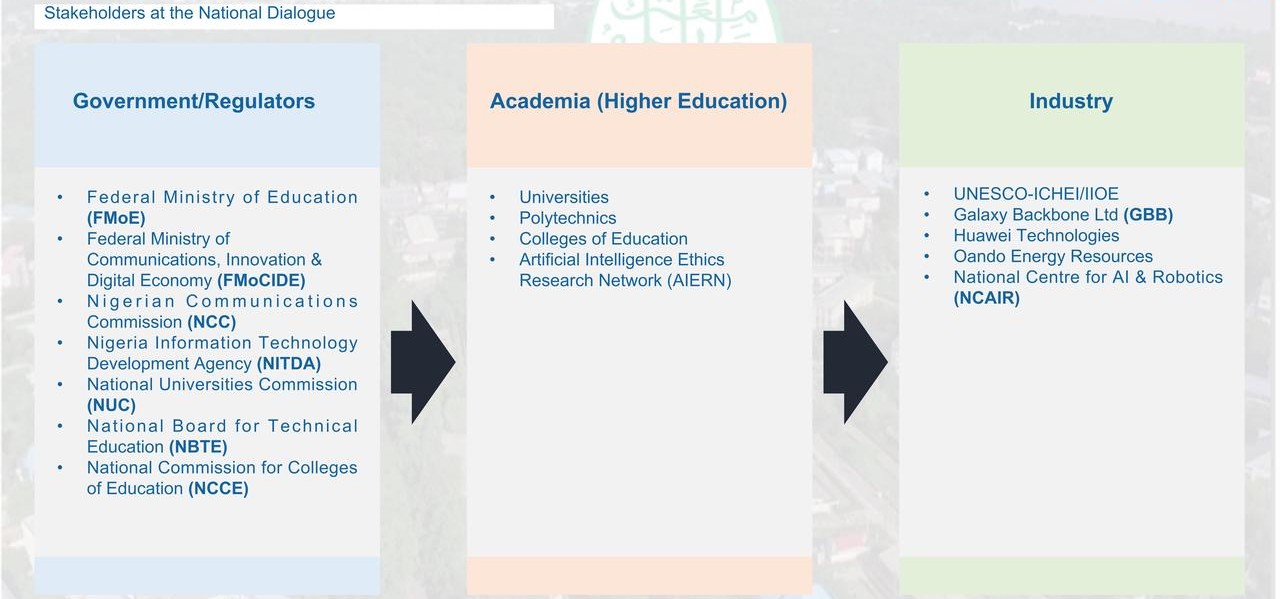
National Dialogue's Stakeholder Breadth
The Draft National Higher Education AI Framework
The 2024 National Dialogue produced Nigeria's first structured roadmap for integrating AI into higher education: The Draft National Higher Education AI Framework. Its key objectives include supporting policymakers, promoting ethical AI use, and identifying opportunities and challenges. The framework was submitted to the Federal Ministry of Education and the National Universities Commission (NUC), and formed the basis for the development of two policy documents by the NUC: Towards Responsible AI Integration in the Nigerian University System and Roadmap for the Integration of Artificial Intelligence into the Nigerian University System.
Micro-Certification and Smart Classroom: Localising IIOE Global Initiatives
The IIOE Nigeria National Centre has effectively localised global initiatives such as the micro-certification project and Smart Classroom (SCR) deployments, aligning them with Nigeria's higher education needs.
Taking the IIOE Micro-Certification Project for Higher Education Workforce Digital Competency Building as an example, the IIOE Nigeria National Centre became the first National Centre to complete the full cycle of a localised micro-course implementation. This milestone was achieved through the domestication of the B1 micro-course, which focused on designing and producing micro-courses to address specific needs in Nigeria's educational environment.
In line with UNESCO-ICHEI's commitment to collaboration and co-development, the Centre also co-designed two new micro-courses: A3 (Design and Produce Presentations) and T1 (Conducting Collaborative Instructional Research with Online and Offline Integration). Both courses are now live on the IIOE portal and accessible to educators across the global network.
Furthermore, the Smart Classroom at ABU Zaria (ABU-CreateView SCR) exemplifies how technology can redefine teaching and learning spaces. It serves as both a demonstration hub and a capacity-building centre for partner institutions. The facility enables richer hybrid delivery, recording and reuse of quality content, more interactive sessions, and the integration of analytics into feedback loops.
Women Leading Change in Africa
Technological empowerment cannot be achieved without broad and inclusive participation. In 2025, the Women Leading Change in Africa project, jointly promoted by the IIOE Nigeria National Centre and UNESCO-ICHEI, is dedicated to providing women in academia with more equitable opportunities for AI literacy enhancement and leadership development. The project integrates sensitisation, training, and micro-certification activities to ensure that women, from faculty and administrators to technical and support staff, are actively involved in shaping AI's future in education.
The project has scheduled a series of blended online and offline activities, attracting nearly 1,300 participants and significantly enhancing the visibility and influence of women in Nigeria's AI and digital transformation landscape. More importantly, a growing community of women educators and administrators is emerging as active practitioners of AI. They are not only accumulating digital competencies but also proactively applying their learning to curriculum innovation, institutional leadership, and policy advocacy.
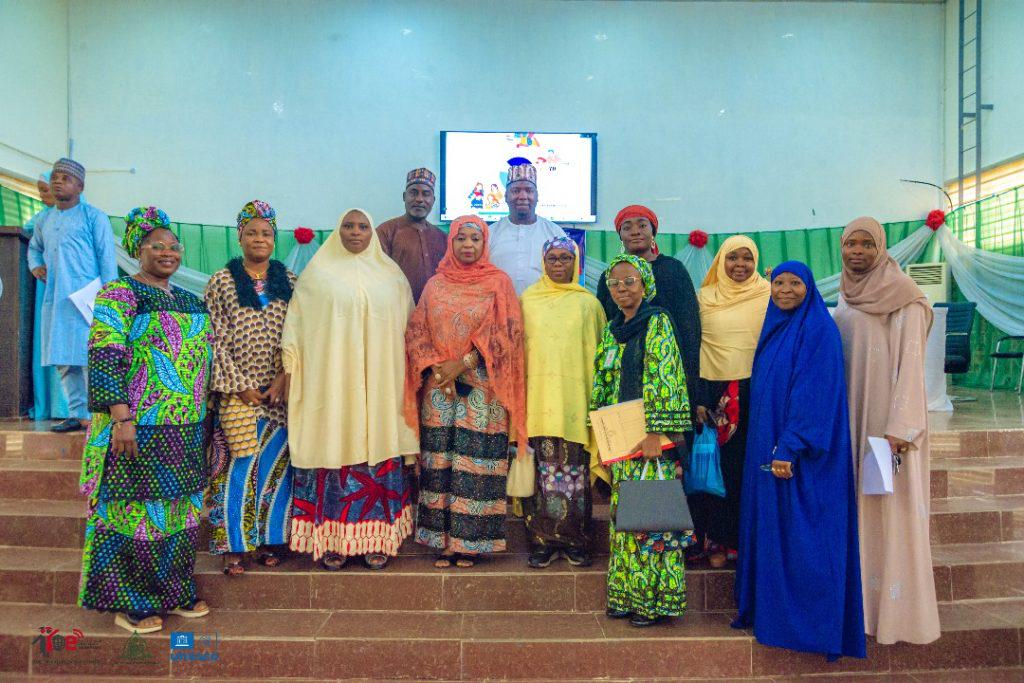
Women Leading Change in Africa Workshop at ABU © IIOE Nigeria National Centre
Best Practices
The IIOE Nigeria National Centre's approach is grounded in replicability and scalability. Across teacher training, policy engagement, and research, several practices stand out. It champions a Quadruple Helix model that brings government, academia and students, industry, and society into the same conversation; advances fit-for-purpose frameworks that help institutions shape AI policies suited to their own contexts; builds a micro-certification ecosystem that links digital skills to lifelong learning pathways; and nurtures collaborative research networks exploring AI ethics and governance.
Together, these efforts have expanded the IIOE Nigeria Network from eight to 16 partner institutions across the country, demonstrating how strategic design can catalyse national impact.
The Beliefs Behind the Mission
At the heart of the IIOE Nigeria National Centre's work are some guiding beliefs. It holds that consensus matters over competition, progress through collective ownership; that capacity must come before technology, because genuine transformation lies in awakening human potential. With an unwavering commitment to equity over advancement, innovation must bridge divides, not create new ones; that equity comes before advancement, so innovation must close, not widen, divides. These convictions flow like a silent river, through every partnership, training, and dialogue, reminding the National Centre why it embarked on the journey of digital transformation, and keeping a human-centred approach.
From Consensus to Continuity
The IIOE Nigeria National Centre's journey from the 2023 institutional dialogue to the 2024 national framework redefines what "consensus-driven digital transformation" means in practice. It demonstrates how inclusive dialogue, grounded research, and genuine localised implementation can guide Nigeria's higher education system into the AI era in a responsible, ethical, and collaborative manner.
Authors
IIOE Nigeria National Centre, ABU Zaria
Muhammed Bashir Mu'azu;
Emmanuel Adewale Adedokun;
Zaharuddeen Haruna;
Basira Yahaya; Yusuf Ibrahim;
Nafisa Shehu Usman
[1] UNESCO (2023). Harnessing the Era of Artificial Intelligence in Higher Education: A Primer for Higher Education Stakeholders.
[2] Federal Ministry of Communications, Innovation & Digital Economy (2024–2028). National AI Strategy.
[3] International Institute of Online Education (IIOE). Micro‑Certification Project and Training Series (access via IIOE platform).

- Bridging the Digital Divide Through GenAI Empowerment: The Mulungushi University Experience
- Weaving a National Digital Ecosystem: ITC and the Making of CCUN
- 2025 New Growth: The IIOE Ecosystem · 2025
- XJTLU: How to Build a Systematic "AI + Education" Ecosystem?
- The Power of Regional Collaboration: IUCEA's AI "Training of Trainers" Programme
- Consensus-Driven Digital Transformation: How the IIOE Nigeria National Centre is Pioneering an AI-Ready Academic Future
- Dialogue with CLOUD: Two Centres, One Pursuit of Excellence
- When Change Knocks: Inside the World of the Pioneer Award